At some point, most growing organizations reach the same decision point: managing IT in-house is consuming too much of the wrong people’s time, or the risks of an under-resourced IT function are becoming impossible to ignore.
So they start looking at managed IT providers.
The typical evaluation process feels reasonable enough. Compare a handful of vendors, check their SLAs, call some references, review pricing, pick the one that looks best. The problem: this process misses most of what actually determines whether the relationship works.
Why SLAs Are Table Stakes, Not Differentiators
Every reputable managed IT provider offers an SLA. Response within four hours. 99.9% uptime. Resolution time benchmarks by severity.
These matter. You should verify they’re realistic and that the contract includes real recourse when they’re missed. But here’s what SLAs don’t tell you: they measure response speed, not outcomes.
A provider can hit a four-hour response time while leaving you with a partially resolved problem that recurs every few weeks. They can meet uptime targets on systems they manage while your cloud costs balloon because no one is actively optimizing your infrastructure. They can resolve tickets on schedule while never identifying the underlying pattern driving the ticket stream in the first place.
Response and outcomes are different things. The evaluation needs to separate them.
What to Actually Evaluate
Strategic Alignment, Not Just Technical Coverage
Reactive IT is a service: fix what breaks, respond to requests. A managed IT partner thinks differently. They understand your business objectives and help you make technology decisions that serve them.
In evaluation conversations, pay attention to this: does the MSP ask about your business goals before proposing a solution? Do they want to understand where you’re headed? Or do they lead with a service catalog and a price per seat?
This matters because the right decisions for a company planning to double headcount in eighteen months are different from the right decisions for a company in stable operations. If your MSP doesn’t know your trajectory, they can’t build toward it with you.
Documentation and Knowledge Transfer
One of the most expensive outcomes in an IT relationship is losing institutional knowledge. When the technician who knows your environment leaves, or when you switch providers, what remains?
Ask directly: what does your documentation practice look like? What format? Who owns it? What does a client receive upon termination?
Strong MSPs maintain current, organized documentation of your environment as part of standard delivery. Weak ones keep knowledge in staff heads, which is a hostage situation whether intentional or not.
Escalation Paths and Depth of Expertise
Most IT issues are routine. The ones that aren’t reveal what you’ve actually bought.
Ask specifically: who handles complex issues your frontline technicians can’t resolve? Is there a tier-two or tier-three team? Do they employ specialists in your critical technologies, or do they call in contractors when things get complicated?
The answer shows whether you’re buying a team with genuine depth or a thin layer that becomes a bottleneck when it matters most.
Proactive vs. Reactive Posture
Reactive support means responding when something breaks. Your provider sees the ticket, shows up, fixes the problem.
Proactive management means monitoring for problems before they become incidents, identifying patterns that predict failures, and recommending changes that prevent issues. It means your provider is thinking about your environment even when nothing is broken.
Ask candidates concretely: what does your proactive monitoring cover? Can you give me an example of a proactive recommendation to a current client and the result? How do you identify that a pattern of small issues points to a larger underlying problem?
Providers who struggle to answer these questions concretely are probably more reactive than they present themselves.
Security Posture and Accountability
IT management and security management have merged. The managed IT provider you choose will have significant access to your systems and data, making them both a security resource and a liability.
Evaluate their security practices with the same rigor you use for operational ones. What certifications or frameworks do they operate under? How do they govern employee access to client systems? What happens if a breach involves their credentials?
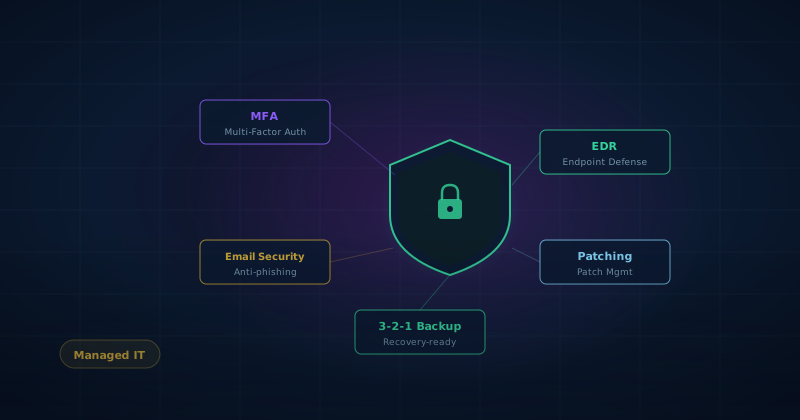
Also evaluate their approach to your security posture. Do they help you implement and maintain appropriate controls (multi-factor authentication, endpoint protection, patch management, email security)? Or does security feel separate from the main conversation?
Vendor Relationships and Independence
Most managed IT providers have preferred vendors, and many have reseller agreements that shape their advice. This isn’t inherently bad, but understanding it matters.
Ask directly: do you have reseller or referral arrangements? How do you ensure recommendations follow client fit rather than margin?
An MSP transparent about vendor relationships and able to articulate how they evaluate alternatives is in a better position than one steering every conversation back to the same small set of products regardless of fit.
Questions That Reveal the Most
Beyond standard evaluation, a few questions cut through the presentation:
“Walk me through how you’d handle a critical outage at 2am on a Saturday.” The specificity of the answer matters. Vague answers (“our team is always available”) differ from concrete ones (“our on-call rotation covers X, escalation to tier-two happens after Y, here are the named contacts”).
“What’s the most common reason clients leave you?” This is an unusual question, which is exactly why it works. A mature provider confident in their service will answer honestly. Evasive answers are informative.
“Can you connect us with a client who had a difficult experience with you and came out satisfied?” Most references are curated for success. This asks for a different kind, one that reveals how the provider handles problems.
“What do you recommend we do that you don’t provide yourself?” A trustworthy partner acknowledges when something is outside their expertise or the wrong fit. A vendor whose answer is always their own services is showing you something.
The Veteran Perspective on Accountability
At TechRev, our approach to managed IT comes directly from military service. In that context, “good enough” isn’t acceptable. The standard is the standard, and the people responsible for an outcome are accountable for it.
This means we maintain documentation as if we’ll be replaced tomorrow. We give honest assessments even when the answer is “you don’t need what we’re selling right now.” We escalate proactively rather than hoping a small problem resolves itself.
We also prefer clients who want a genuine partner over clients who want minimum-viable IT. Shared expectations about what the relationship is for matter more than almost anything else in a managed IT engagement.
Making the Final Call
After evaluation, you’re assessing who you want a long-term working relationship with, not just comparing capabilities and price.
The managed IT relationship touches your systems daily. When something fails, the quality of that relationship determines whether you feel supported or on your own. Cultural fit, communication style, and demonstrated accountability matter as much as technical capabilities.
Get the evaluation right. The cost of switching managed IT providers, in disruption and lost context, is high enough that thorough upfront work pays for itself.
If you’re currently evaluating managed IT options and want a candid perspective on what to look for in your situation, we’re happy to help. Even if TechRev isn’t ultimately the right fit.
TechRev Service
Managed IT Services
Proactive infrastructure management, security monitoring, patch management, and helpdesk support — we keep your technology running so your team stays focused on the mission.
See our managed IT servicesAI helped write this. Our team made sure it was worth reading.