We built an agent that handles client intake. It reads incoming requests, routes them to the right team, drafts initial responses, and flags anything it is not sure about. That is an agent.
A language model, the kind you talk to through a chat interface, takes input and produces output. You ask a question, you get an answer. It does not remember what you said before, does not take actions outside itself, and does not decide to do anything on its own.
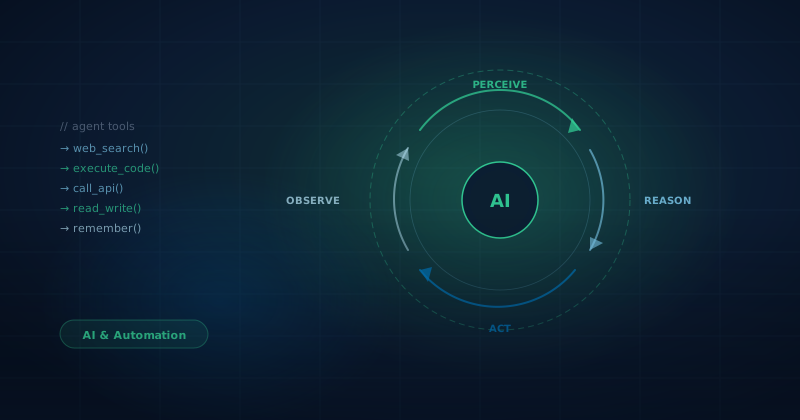
An agent works differently. It operates in a loop that repeats until a task is done.
- Perceive - the agent receives input (a task, a document, an event, an incoming message)
- Reason - it uses a language model to interpret that input and decide what to do
- Act - it executes an action: calling an API, writing to a database, running a search, sending a notification
- Observe - it checks the result of that action
- Repeat - it continues the loop until the task is complete or it reaches a boundary
That loop separates an agent from a model call. Agents work through multi-step sequences. They adapt when intermediate results change. They pursue a goal rather than just respond to a prompt.
The Tools That Make Agents Work
A language model on its own cannot act in the world. What gives an agent its capabilities is its access to tools.
In production, we use:
- Web search - retrieve current information not in training data
- Code execution - run Python, SQL, or shell commands and use the output
- API integrations - interact with external systems: CRMs, ticketing platforms, cloud infrastructure
- File I/O - read and write documents, spreadsheets, structured data
- Memory - store and retrieve context across sessions or between workflow steps
- Sub-agents - delegate specific tasks to other specialized models
The tools determine what an agent can actually accomplish. A customer support agent with access to your ticketing system and knowledge base can look up order history, update records, escalate issues, and draft responses. An agent without those integrations is just a chatbot with extra steps.
When Agents Actually Work
The use cases where agents deliver value share one thing: they involve multiple steps that require judgment, not just rules, and the volume makes human handling impractical.
We see reliable results in these areas:
- First-pass triage - reading incoming support tickets, classifying them by type and urgency, routing to the right queue, and drafting an initial response for human review
- Research and synthesis - gathering information from multiple internal and external sources and producing a structured summary or recommendation
- Code review assistance - scanning pull requests against coding standards, flagging common issues, generating specific review comments
- Data monitoring - watching pipelines for anomalies, investigating when something looks wrong, and notifying the right person with context
- Internal knowledge retrieval - answering employee questions by searching documentation, runbooks, and policy documents
- Workflow orchestration - routing requests through multi-step processes (approvals, reviews, sign-offs) with context automatically attached at each step
Agents struggle here:
- Tasks that require physical verification or presence
- Decisions that need human accountability for legal or compliance reasons
- Highly novel situations without enough similar precedent to reason from
- Irreversible actions where mistakes are expensive to fix
The last category is the hard one. Getting the reasoning right is not the difficult part. Modern language models reason well. The hard part is designing the action space so that mistakes are recoverable. A well-designed agent knows what it is allowed to do autonomously and what it should escalate or confirm before acting.
The Spectrum
Not all agents are the same.
Single-purpose agents handle one defined task: extract data from a PDF and populate a spreadsheet, or monitor a Slack channel and file tickets when certain keywords appear. These are agents in the technical sense, but they are closer to smart automations. They are often the right place to start.
Multi-step reasoning agents work through a sequence of decisions to pursue a goal. An agent asked to “research our three main competitors and produce a comparison” will plan searches, read pages, synthesize findings, and write structured output. This might involve dozens of individual actions, adjusting its approach based on what it finds.
Multi-agent systems coordinate multiple specialized agents, each with a defined role. One agent writes code, another writes tests, another checks for security issues, and an orchestrator manages the workflow. These systems tackle genuinely complex problems but require careful architecture.
Most organizations find real value from simple, focused agents long before they need multi-agent coordination. Starting small is not a limitation. It is good engineering.
Should You Build One?
Ask these questions honestly.
Is the process well-defined? Agents work when success has a clear definition. If you cannot articulate what a correct outcome looks like to a human employee, an agent will struggle too.
What is your tolerance for errors? Some workflows absorb occasional AI mistakes because a human reviews the output. Others cannot afford errors at all. The acceptable error rate directly shapes how much testing and guardrailing you need.
What is the volume? A task that happens twice a week does not justify building an agent. A task that happens five hundred times a day, or one that interrupts engineers constantly with low-stakes decisions, is a strong candidate.
Do you have the integrations? Agents are only as useful as the data they can reach. If critical information lives in systems with no API, the agent project involves solving an integration problem first.
What happens when it fails? Every agent will encounter something it cannot handle. The fallback behavior (escalate to a human, log and skip, pause and alert) needs to be intentionally designed, not discovered in production.
How We Build Agents
TechRev builds custom AI agents for clients and uses agents internally across our engineering workflows. A few principles that matter:
Start narrow, then expand. The most successful deployments started with a tightly scoped problem: one workflow, one data source, one clear success metric. Once that works reliably, the scope expands. Trying to build broadly from the start produces an agent that does many things poorly rather than one thing well.
Human-in-the-loop by default. For any action with real-world consequences, we build confirmation steps rather than autonomous execution until the agent has earned trust through observed performance over time.
Observability first. You cannot improve what you cannot see. Every agent we build has structured logging, tracing, and monitoring from day one. Without it, debugging failures in production is close to impossible.
The model is not the product. Which language model you use matters less than how you design the surrounding system: the tool set, the memory architecture, the error handling, the escalation logic. We have seen thoughtfully designed agents on smaller models outperform lazy implementations on cutting-edge ones.
If you are trying to figure out whether an AI agent makes sense for a specific problem in your organization, that is a conversation worth having before writing any code. We are always glad to help think it through.
TechRev Service
AI Platform Engineering
We design and build custom AI agents, workflow automations, and intelligent platforms that bring AI into your business as native capability.
See our AI PlatformAI helped write this. Our team made sure it was worth reading.