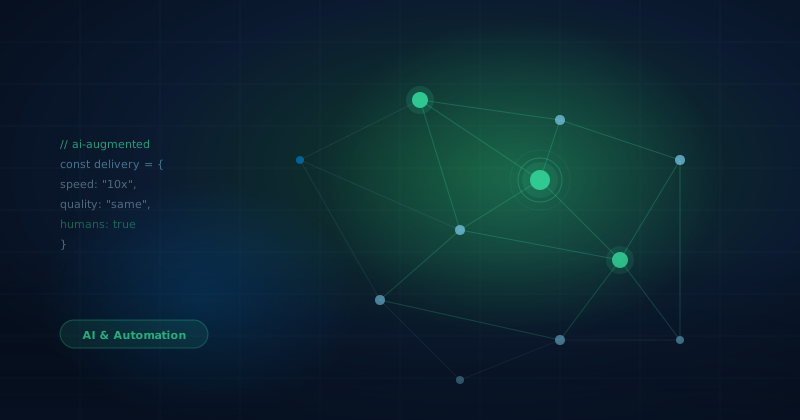
When we say AI-augmented delivery, we’re not talking about a chatbot that writes boilerplate or a code completion plugin that saves a few keystrokes. We mean a fundamentally different way of working. AI is embedded in how we scope, architect, develop, test, and document software from the first conversation to the final deployment.
This is not theoretical. It is how we work today, on every project, across every team.
It’s also a meaningful change in what clients get from a technology services engagement. The phrase “AI-assisted development” gets applied to everything from autocomplete to full-stack code generation. Some of it is genuinely transformative. Some of it is essentially cosmetic. This is not the cosmetic version.
How We Got Here
Two years ago, we started integrating AI tools into specific parts of our workflow. First came documentation and test generation, where the productivity gains were immediate and obvious. Then we moved progressively deeper into architecture exploration and development itself.
What we discovered was this: the quality of AI-assisted work depends entirely on the quality of the process around it. An AI tool given a vague prompt produces vague output. An AI tool operating inside a disciplined workflow produces work that’s genuinely production-grade.
The workflow matters more than the tool.
We built those workflows deliberately. We refined them through actual client engagements. They’re part of how TechRev operates now, not a capability we bolt on when we need a performance bump.
What AI-Augmented Development Looks Like Phase by Phase
Scoping and Architecture
Before writing code, we use AI to accelerate technical discovery. When evaluating architectural approaches, we explore tradeoffs at a speed that was previously impossible. Should we build a monolith or microservices? Which data persistence pattern fits the access patterns? How should we structure an API to support future extensibility?
A senior engineer can walk through five or six architectural variants in the time it used to take to think carefully through two. The exploration is richer. The decision is more informed. The reasoning gets documented, which means the decision isn’t locked in someone’s head.
This phase is still deeply human. The AI surfaces options. The engineer applies judgment, organizational context, and domain experience to make the call.
Development
Code generation is the most visible part of AI-augmented development and the most frequently misunderstood. We’re not using AI to eliminate engineers. We’re using it to change what engineers spend their time on.
AI handles boilerplate well. Repetitive patterns. Translating a well-specified function signature into an implementation. Writing adapters between systems. Scaffolding new services from established patterns. These are real tasks, and they’re time-consuming when done manually. Offloading them frees engineering attention for work that genuinely requires human judgment: complex business logic, edge case handling, security-sensitive code, performance-critical paths.
Every piece of AI-generated code goes through the same review process as human-authored code. Our engineers read it, understand it, and own it. If they can’t explain why the code does what it does, it doesn’t merge. This isn’t a safety policy we added late. It’s how you build software that doesn’t fall apart six months later.
Test Coverage
Test generation is one of the highest-leverage applications of AI in a software development workflow. Writing comprehensive test suites is important, time-consuming, and the kind of work that gets cut when schedules tighten.
AI tools let us write tests in parallel with features rather than sequentially after them. The coverage improves. The velocity stays up. We’re not choosing between moving fast and testing thoroughly. We do both.
The result is a test suite that actually reflects intended behavior, catches regressions reliably, and gives the team confidence when making changes. That confidence compounds over the life of a project.
Documentation
Technical documentation is the thing most software projects do badly. Not because engineers don’t understand the system. They do, at the moment they’re building it. But writing clear prose about what you just built is a different skill from building it. There’s rarely time budgeted for it.
AI tools generate accurate technical documentation directly from code and context. API references. Architectural decision records. Runbooks. Onboarding guides. These get written as the project progresses, not in a sprint at the end that gets cut.
For clients, this matters practically. When you receive a codebase from TechRev, it comes with documentation that reflects how the system actually works, not aspirational documentation written from memory.
What Doesn’t Change
The productivity gains are real. Work that used to take months takes weeks. Work that took weeks takes days. But several things stay exactly the same.
Our engineers still own every line of code. AI generates. Engineers review, refine, and accept or reject. Nobody ships code they don’t understand.
We still conduct architecture, code, and security reviews. The process hasn’t been simplified. The tools in the process have gotten better. Reviews catch more because there’s more to review.
We still test in production-equivalent environments. Faster development doesn’t mean skipping the validation that makes software reliable.
We still respond when things go wrong. If something breaks at 2am, TechRev engineers handle it. Production incidents still require humans who understand the system end-to-end. AI tooling is part of how we build. It’s not load-bearing when production needs a human.
We still take accountability for outcomes. The deliverable is working software that serves your mission, not a pile of AI-generated code that technically runs.
What This Means For You
When you engage TechRev, you get the velocity benefits of AI-augmented development without the overhead of standing it up yourself. Building reliable AI-assisted development workflows takes time: the prompt engineering, the review processes, the tooling, the learned intuition about which outputs to trust. We’ve already done that work.
You get faster delivery. You get better documentation. You get test coverage written alongside features rather than after them. You get a team that can explain exactly what was built and why, because we own the code.
AI amplifies engineering skill. The same talented engineer produces significantly more in the same amount of time and can explore more options before committing. Decisions get documented as they’re made.
This is what AI-augmented delivery means at TechRev. Not faster shortcuts. A higher ceiling on what a skilled engineering team can accomplish.
TechRev is a Veteran-Founded technology services company based in Florida, USA. We build and operate custom platforms, AI agents, and managed infrastructure for businesses that depend on technology to run their mission.
TechRev Service
AI Platform Engineering
We design and build custom AI agents, workflow automations, and intelligent platforms that bring AI into your business as native capability.
See our AI PlatformAI helped write this. Our team made sure it was worth reading.