There’s a point in most engineering organizations’ growth where something quietly breaks.
The team is shipping features. The product is working. But developers spend more and more time waiting: waiting for environments to provision, waiting for CI runs to finish, waiting for infrastructure requests to clear a queue. Eventually, waiting on the one senior engineer who understands the deployment pipeline.
Velocity slows. Frustration grows. The bottleneck isn’t talent or effort. It’s the platform underneath.
Platform engineering exists to solve that problem. Over the past several years, it’s matured from a concept at hyperscale companies into a practical discipline that fifty-person teams can use to dramatically improve how they build and ship software.
What Platform Engineering Actually Is
Platform engineering is the discipline of building and maintaining internal products that make software developers more productive.
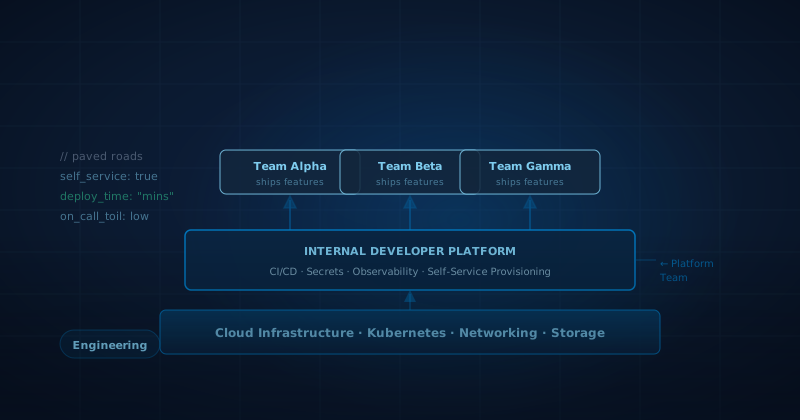
The output of a platform engineering team is typically an Internal Developer Platform (IDP). This is a set of self-service tools, automations, templates, and abstractions that let developers do their work without needing to understand every layer of infrastructure beneath them.
Where DevOps focuses on culture and collaboration between developers and operations, platform engineering treats the developer experience itself as a product problem. The customer is internal. They have pain points. Your team’s job is to solve them systematically.
The platform team builds the roads. Product teams drive on them.
Platform Engineering vs. DevOps: What’s the Difference
These terms are often used interchangeably. They’re not the same thing.
DevOps is a cultural and operational philosophy. Break down the silos between development and operations. Share ownership of reliability and deployment. Move toward continuous delivery. It’s about how teams collaborate and think.
Platform engineering builds systems that make that collaboration scale. When your organization grows, “everyone does DevOps” stops working. Every team becomes responsible for understanding Kubernetes, configuring CI/CD pipelines, managing secrets, operating observability stacks. The result: duplicated effort everywhere, and infinite variation in how things get done.
A platform team creates a shared, opinionated layer that other teams rely on. Instead of each team configuring their own deployment pipeline, the platform provides a standard one they can adopt in a day. It’s not a loss of autonomy. It’s moving the autonomy to where it matters.
DevOps principles don’t disappear. Platform teams typically embody them fiercely. But they apply those principles to building infrastructure products, not application features.
The “Paved Roads” Concept
Think of a paved road. You can navigate on a dirt path. It’s slower, more difficult, more likely to fail when conditions change. A paved road is faster, predictable. Most people should use it. If you need to go somewhere the road doesn’t reach, go off-road. Accept the cost.
A good internal platform provides paved roads for the most common developer journeys: creating a new service, running tests, deploying to staging, shipping to production, viewing logs, setting up alerts. These paths are well-documented, maintained by the platform team, and fast.
Teams with unusual requirements can go off-road. The platform makes the typical case easy, which is where the majority of developer time goes.
Signs Your Organization Needs Platform Engineering
Not every team needs a dedicated platform engineering function. A team of ten engineers with a simple deployment setup probably doesn’t. But several indicators suggest the time has come.
Deployment requires tribal knowledge. If shipping to production involves steps only two or three people know how to execute, you have a platform problem. Every deployment that blocks on a specific person is a reliability risk and a bottleneck.
Onboarding takes weeks. New engineers spend their first two weeks getting their local environment set up and learning to deploy a change. The platform is failing them. A mature platform gets a new hire shipping changes in their first few days.
Infrastructure requests sit in a queue. Developers submit tickets and wait for provisioning. They’re working around the platform’s limitations. Self-service is the goal.
Every team has its own way of doing everything. Some variation is healthy. Teams should own their technical choices. But when every team has built a different CI pipeline, a different observability setup, a different deploy process, you lose leverage.
Reliability incidents are hard to diagnose. Tracing an incident requires reading three different logging tools and calling the engineer who set up the system eighteen months ago. Observability is a platform problem.
What a Good Internal Developer Platform Looks Like
A well-built IDP doesn’t need to be complicated. The essential capabilities cluster around a few areas.
Service provisioning. Creating a new service with a repository, CI/CD pipeline, staging environment, and monitoring should be self-service and take less than an hour. Not a multi-day process with manual steps and approvals.
Deployment and promotion. The path from a merged pull request to production should be standardized, automated, and observable. Developers should understand what’s happening without needing to know the infrastructure details.
Secrets and configuration management. Applications need access to credentials and environment-specific configuration. The platform should provide a secure, consistent mechanism. Teams shouldn’t improvise their own approaches.
Observability. Logs, metrics, and traces should be available in a consistent format across all services. An on-call engineer should be able to jump into any service and understand what it’s doing.
Developer environments. Local development should closely mirror production without requiring developers to maintain complex local infrastructure. Ephemeral environments for testing branches are increasingly standard.
You don’t need to build all of this at once. The highest-value starting points vary by organization. Deployment standardization and observability consistently appear near the top.
Getting Started Without a Dedicated Team
Platform engineering doesn’t require hiring a dedicated team immediately. It starts with treating infrastructure investment as a product investment rather than a maintenance cost.
In practice, this means designating a rotation of engineers from existing teams to focus on platform improvements for a quarter. Identify the top three developer experience complaints. Build solutions that more than one team can use. Document them. Iterate.
Treat internal tools with the same rigor as external products. User research. Design. Iterative releases. Feedback loops.
As the platform matures and the investment proves its value, dedicated platform engineering becomes justifiable and usually self-funding. The productivity gains reliably outweigh the cost of the team.
The Business Case
The ROI on platform engineering can be hard to quantify precisely, but some proxies are useful.
Developer time spent on infrastructure versus application work is a direct measure. If engineers spend 30% of their time dealing with deployment, environment, and operational overhead rather than building product, reducing that by half returns significant capacity without adding headcount. This is realistic.
Time-to-production for a new service is another benchmark. The difference between “three weeks with tickets and coordination” and “an afternoon with self-service tooling” compounds across every new service.
Incident mean time to resolution (MTTR) is another proxy. Better observability and standardized runbooks consistently reduce the time engineers spend diagnosing and resolving production issues.
Platform engineering isn’t a cost center. It’s an investment in the speed and reliability of everything else the organization builds.
If your engineering team is feeling the friction of growth, a platform engineering conversation is the right place to start. Slower deployments. Knowledge silos. Inconsistent tooling. These are all signals. We’ve helped teams assess where the highest-value platform investments are. Reach out if that’s useful.
TechRev Service
Platform & Software Engineering
From architecture through deployment, we design and build custom platforms and applications — with AI-accelerated workflows that deliver faster without cutting corners on quality.
See our engineering servicesAI helped write this. Our team made sure it was worth reading.